
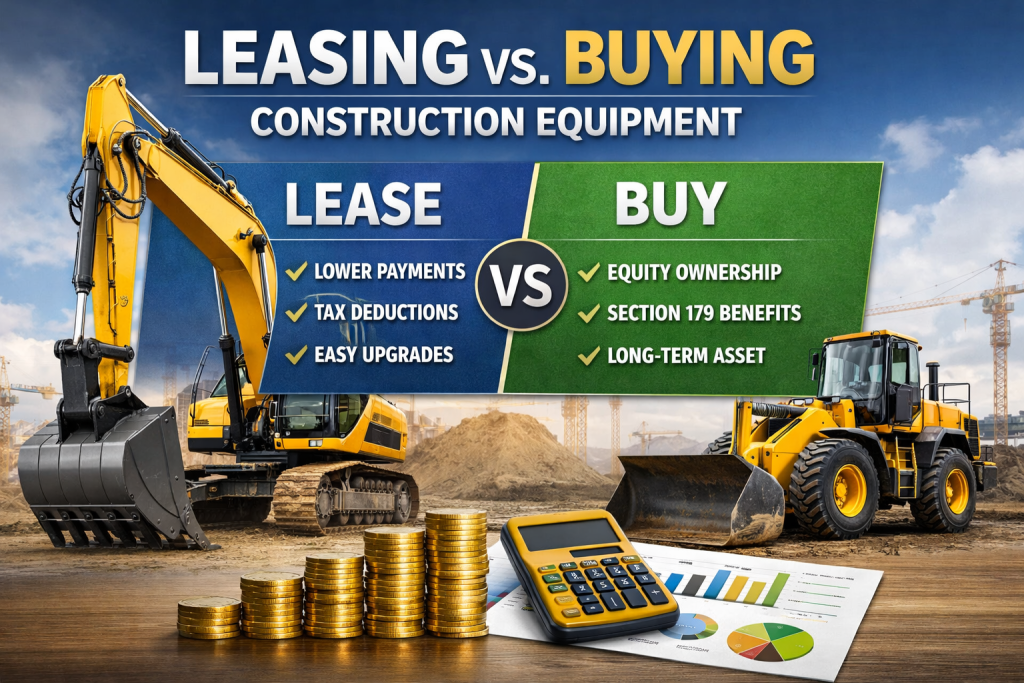
Leasing vs. Buying Construction Equipment: A Cash Flow and Tax Advantage Analysis
Do you know the different advantages between leasing vs buying construction equipment? Construction companies rely heavily on specialized equipment to complete projects efficiently and profitably. Excavators, loaders, cranes, and other heavy machinery often require a significant capital investment. Therefore, contractors must carefully evaluate how they acquire these assets.
Because of these high costs, many contractors must decide between leasing equipment or purchasing it outright. While buying equipment provides ownership benefits, leasing often offers advantages in cash flow management, tax deductions, and equipment upgrade flexibility.
Ultimately, understanding the financial and operational differences between leasing and buying can help construction companies make smarter decisions that support both growth and long-term profitability.
Cash Flow Advantages: Preserving Working Capital
One of the biggest considerations for contractors is cash flow management. Construction businesses frequently face payment delays due to retainage, milestone billing, and pay-when-paid contracts. As a result, large equipment purchases can quickly strain liquidity and limit a company’s ability to fund ongoing projects.
Equipment Leasing and Cash Flow
Leasing typically requires:
Lower upfront costs
Predictable monthly payments
Minimal or no down payment
Because of these factors, leasing allows contractors to preserve working capital for payroll, materials, and operational expenses.
In addition, leasing helps companies avoid tying up large amounts of capital in depreciating assets. Instead, businesses can allocate those funds toward growth opportunities, project expansion, or additional hiring.
Equipment Purchasing and Cash Flow
On the other hand, buying equipment often requires:
Significant upfront capital
Large loan payments or financing
Higher balance sheet liabilities
Consequently, ownership may reduce financial flexibility during slower construction cycles or delayed project payments. However, some companies prefer ownership because it allows them to build equity in valuable equipment assets.
For this reason, contractors must evaluate both liquidity needs and long-term financial strategy before deciding which option works best.
Tax Benefits: Section 179 and Lease Deductions
Tax advantages also play a major role in the leasing vs buying construction equipment decision.
Benefits of Buying Equipment
When construction companies purchase equipment, they may qualify for several tax deductions. For example, businesses can often take advantage of:
Section 179 deductions
Bonus depreciation
Standard depreciation over the asset’s useful life
As a result, these deductions can significantly reduce taxable income in the year the equipment is purchased.
However, the value of these deductions depends on profitability and tax planning strategies. If a company has limited taxable income, the immediate benefits may be less significant.
Benefits of Leasing Equipment
Leasing, however, often provides simpler tax treatment. In many cases, lease payments are fully deductible as operating expenses.
Therefore, businesses can deduct the payment amount during the same year it is paid.
Additionally, this approach creates consistent tax deductions throughout the lease term, making budgeting and financial forecasting easier for many contractors.
Equipment Upgrade Cycles and Technology
The construction industry continues to adopt new technology, automation, and fuel-efficient machinery. As technology evolves, equipment that was cutting-edge just a few years ago may already be outdated.
The Advantage of Leasing for Equipment Upgrades
Leasing allows construction companies to upgrade equipment more frequently. For instance, contractors can replace machinery at the end of the lease term rather than maintaining aging equipment.
Furthermore, companies can stay competitive by using modern equipment that improves productivity, safety, and jobsite efficiency.
The Ownership Advantage
Nevertheless, buying equipment can still make sense under certain circumstances.
For example, ownership may be beneficial when:
The machinery will be used long term
Maintenance costs remain manageable
Technology changes slowly for that equipment type
In particular, durable assets such as trailers or basic loaders often provide value for many years after purchase.
Maintenance and Lifecycle Costs
Another key factor is the total cost of ownership.
When equipment is purchased, contractors are responsible for several ongoing costs. These include repairs, maintenance, storage, transportation, and long-term depreciation.
Meanwhile, leasing agreements may include maintenance packages or warranty coverage. Because of this, companies can reduce the risk of unexpected repair costs.
As a result, leasing often provides greater cost predictability, which can be especially beneficial for small and mid-sized construction companies.
When Leasing Makes More Sense
Leasing construction equipment may be the better choice when:
Cash flow is a priority
Equipment technology changes rapidly
The machinery is needed for specific project cycles
Businesses want predictable monthly expenses
Contractors prefer regular equipment upgrades
In these situations, leasing provides operational flexibility while reducing upfront capital requirements.
When Buying Equipment Is the Better Option
However, purchasing equipment may make more sense when:
The machinery will be used for many years
The company has strong capital reserves
Long-term depreciation benefits are valuable
Equipment resale value remains strong
Therefore, ownership can be beneficial for contractors with stable workloads and long equipment lifecycles.
Common Equipment Contractors Lease or Finance
Construction companies frequently lease or finance equipment such as:
Excavators
Bulldozers
Backhoes
Wheel loaders
Cranes
Dump trucks
Skid steers
Because these machines represent large capital investments, many contractors choose equipment leasing or financing solutions to maintain flexibility and protect working capital.
Choosing the Right Equipment Financing Strategy
Every construction business operates differently. Because of this, the best decision depends on several factors including project pipeline, tax strategy, cash flow stability, and equipment lifecycle.
✔ In today’s competitive construction market, equipment financing decisions can significantly impact profitability, liquidity, and scalability.
Understanding the differences between leasing and buying helps contractors maximize both financial flexibility and operational performance.
Leasing vs Buying Construction Equipment Comparison
| Factor | Leasing Equipment | Buying Equipment |
|---|---|---|
| Upfront Cost | Low or no down payment | High upfront capital required |
| Monthly Payments | Predictable lease payments | Loan payments or full purchase cost |
| Tax Treatment | Lease payments often fully deductible | Section 179 and depreciation deductions |
| Cash Flow Impact | Preserves working capital | Reduces liquidity initially |
| Equipment Upgrades | Easy upgrades every few years | Must sell or trade equipment |
| Maintenance Costs | Often included in lease terms | Owner responsible for all repairs |
| Long-Term Ownership | No ownership unless buyout option | Full ownership of asset |
In many cases, contractors use a hybrid approach. For example, they may purchase core equipment while leasing specialized or rapidly evolving machinery.
Ultimately, by evaluating cash flow needs, tax implications, and upgrade cycles, construction companies can select the financing strategy that supports long-term growth and operational efficiency.
*More Information on Leasing vs Buying
Need Help Financing Construction Equipment?
Choosing between leasing and buying construction equipment can have a major impact on your company’s cash flow, tax strategy, and long-term growth.
Many contractors combine equipment leasing with working capital solutions to maintain liquidity while expanding their fleet.
If your construction company needs financing options for heavy equipment, working capital, or project growth, exploring the right funding strategy with First Capital can help you scale faster and operate more efficiently. Contact Us Today!